
I recently ordered the book “Hilma af Klint: What stands behind the flowers” by MOMA. I was intrigued to know more. I found it very interesting that her floral studies were AFTER her large symbolic abstracts, so I asked Chat GPT about her later works, after these florals. This post contains that very interesting information.
How old was Hilma Klint when she did her floral studies?
Her Nature Studies (the series of flower and plant drawings she made in 1919–1920), Hilma af Klint was about 56–57 years old when she created them.
- She was born on October 26, 1862.
- The Nature Studies portfolio was created during 1919–1920.
These botanical watercolors were made late in her career, after her major abstract works of 1906–1915, and combined detailed observation of flowers with her spiritual ideas about the relationship between plants and human consciousness.
After her 1919–1920 Nature Studies, Hilma af Klint continued to make work that blended observation of nature with spiritual and symbolic ideas.
Some of her main activities in the 1920s included:
- Spiritual and esoteric diagrams – She created geometric compositions, charts, and symbolic drawings influenced by her interests in spirituality, especially ideas from Anthroposophical Society and the teachings of Rudolf Steiner.
- Watercolor series exploring nature and consciousness – Rather than returning to purely representational painting, she increasingly used flowers, plants, colors, and abstract forms as symbols for invisible forces, growth, and spiritual evolution.
- The “On the Viewing of Flowers and Trees” series (1922) – This group of watercolors combined botanical observation with abstract and symbolic elements, showing her effort to connect the physical world with spiritual realities.
- Notebooks and research drawings – A significant portion of her later work consisted of illustrated notebooks filled with diagrams, writings, color studies, and visual investigations into religion, science, mathematics, and nature.
Her style after Nature Studies generally became more contemplative, symbolic, and diagrammatic. She moved away from the large, groundbreaking abstract paintings of the 1900s and focused increasingly on works that attempted to explain spiritual concepts through visual systems.
One interesting aspect of her late career is that she believed much of her art would not be understood by her contemporaries. She arranged for many of her works to remain unseen until decades after her death, which is one reason her importance to the history of abstraction was recognized only much later.

Hilma af Klint lived to the age of 81.
- She was born on October 26, 1862, in Stockholm.
- She died on October 21, 1944, just five days before her 82nd birthday.
Her death followed a traffic accident involving a tram in Stockholm. By the time she died, she had produced more than 1,000 artworks and left instructions that much of her work should remain unpublished for many years because she believed future generations would be better able to understand it.
It's remarkable that the floral and botanical studies discussed earlier were made when she was in her mid-to-late 50s, and she continued making art and spiritual research drawings for roughly another two decades afterward.
Yes. A number of works that Hilma af Klint created in her 70s are available both online and in published books, although her late work is less widely reproduced than her famous early abstract paintings.
Online
The best places to see authenticated images of her later work include:
- Hilma af Klint Foundation Digital Archive — The foundation maintains a large archive of her paintings, watercolors, notebooks, and later spiritual studies.
- The Museum of Modern Art (MoMA) Hilma af Klint resources — Includes essays and images from different periods of her career.
- Google Arts & Culture: Hilma af Klint — Features high-resolution images and exhibition material.
For works specifically from the 1930s (when she was in her 70s), search for:
- On the Viewing of Flowers and Trees
- Late notebooks and diagrams
- Anthroposophical studies
- Watercolor studies from the 1930s
Books
Several books reproduce her later work:
- Hilma af Klint: A Biography — A detailed biography with illustrations spanning her entire life, including her later decades.
- Hilma af Klint: Paintings for the Future — The major retrospective catalog; includes essays and works from multiple periods.
- Hilma af Klint: The Blue Books — Focuses on her notebooks and spiritual investigations, including material from her later years.
- Hilma af Klint: Visionary — Contains a broad selection of paintings and works on paper.
One thing many readers notice is that her art in her 70s often feels different from the dramatic abstractions she made in her 40s. The later works can be quieter, more diagrammatic, and more focused on synthesizing nature, spirituality, and knowledge into visual systems. If you're interested in seeing what an artist's work looked like in old age, her late notebooks and watercolor studies are especially revealing because they show her continuing to experiment and think visually well into her seventies.
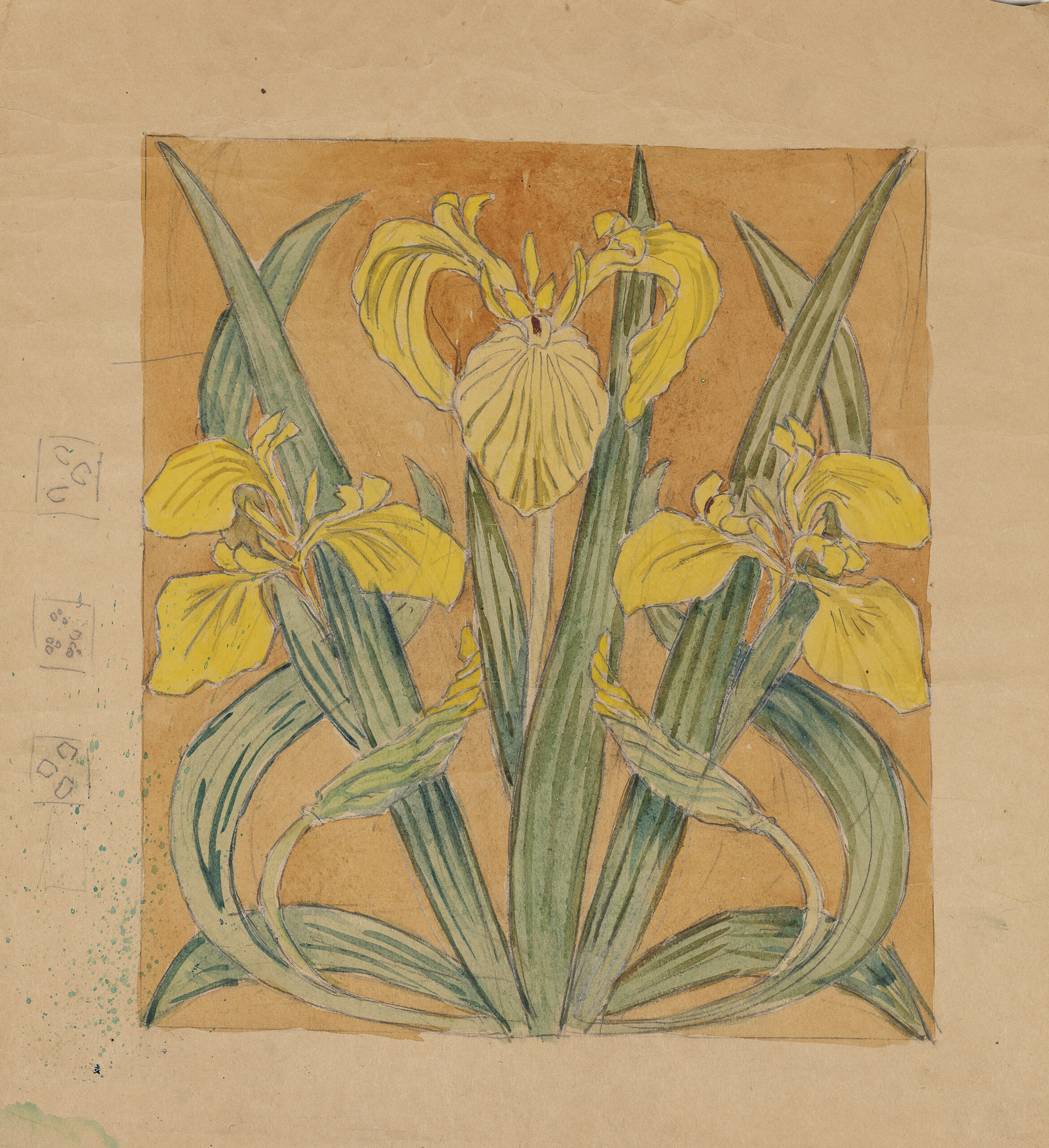
We know quite a bit about the materials used by Hilma af Klint, although not every work has been scientifically analyzed.
Paints
Her paintings and works on paper were made primarily with:
- Oil paint (especially in her large abstract series from 1906–1915)
- Watercolor
- Gouache (opaque watercolor)
- Ink
- Graphite and colored pencil in notebooks and studies
The colors in her work tend to be surprisingly clean and luminous. Conservators have found that she often worked with commercially available artist pigments rather than unusual homemade materials. Her palette frequently includes:
- Ultramarine and cobalt blues
- Rose and pink tones
- Yellows ranging from pale lemon to golden ochre
- Soft greens
- Black and white for geometric and diagrammatic elements
Paper
For her botanical studies, notebooks, and many later works, she typically used:
- Medium-weight drawing paper
- Watercolor paper
- Sketchbooks and bound notebooks
- Large sheets of paper mounted or stored flat
Her paper was generally the sort available to a professionally trained European artist of the late 19th and early 20th centuries—good quality but not especially luxurious. She appears to have valued the ideas and investigations more than precious materials.
Canvas and Supports
For the famous large abstractions such as The Ten Largest, she often painted on:
- Paper mounted to canvas
- Prepared canvases
- Large-format supports assembled for monumental works
Some of these paintings are enormous—over 3 meters (10 feet) tall—suggesting she was willing to experiment physically as well as conceptually.
Notebooks and Late Work
In her 60s and 70s, a great deal of her work shifted toward:
- Watercolor on paper
- Ink diagrams
- Annotated drawings
- Handwritten notebooks containing both text and images
The notebooks themselves became artistic objects. She would combine color, geometry, botanical observation, symbols, and writing on the same page, creating something between a scientific notebook, a spiritual journal, and an artist's sketchbook.
Surface Qualities
One striking thing about her late works is how lightly handled many of them are. Unlike the thickly painted surfaces of some modernists, her later watercolors often have:
- Thin transparent washes
- Precise line work
- Delicate layering
- Minimal texture
The effect can feel almost architectural or scientific—more like visual thinking than expressive brushwork.
If you're interested in recreating the feel of her late floral and spiritual studies, a modern equivalent would be watercolor and gouache on smooth watercolor paper, with graphite, ink, and colored pencil used for diagrams and annotations. The materials are relatively modest; much of the distinctive character comes from her unusual combination of botanical observation, geometry, symbolism, and handwritten notes.